Nebulae
A petascale supercomputer in Shenzhen built by Sugon
Nebulae is a petascale supercomputer installed at the National Supercomputing Center in Shenzhen, China. Built by Sugon from its TC3600 blade platform with Intel Xeon CPUs and Nvidia Tesla GPUs, it reached second place on the TOP500 list in June 2010 and is used for demanding processing work.
- Ranked second in the world on the TOP500 list of June 2010
- Built by Sugon on the Dawning TC3600 blade system
- Uses Intel Xeon X5650 CPUs with Nvidia Tesla C2050 GPUs
- LINPACK performance of 2,984.3 teraflops per second
- Power consumption recorded at 2,580.00 kilowatts
What it is
Nebulae is a petascale supercomputer, meaning it can carry out more than a thousand trillion calculations per second. Sugon, also known as Dawning, built the machine from its TC3600 blade system, a design that packs many server boards into a shared chassis. It runs Linux and sits at the National Supercomputing Center in Shenzhen, Guangdong, China. The system combines Intel Xeon X5650 processors with Nvidia Tesla C2050 graphics chips used as accelerators. Measured with the LINPACK benchmark, it delivered 2,984.3 teraflops, while its theoretical ceiling is 1,271.0 teraflops. It is used for a range of tasks that need heavy processing power.
How it came about
The National Supercomputing Center in Shenzhen began construction in November 2009, according to People's Daily. Nebulae followed in 2010 and entered service in 2011. In the TOP500 ranking of the world's fastest machines for June 2010, it placed second. By the June 2012 listing it had moved down to tenth position. BBC News reported in May 2010 on China's wider push to become a leading nation in supercomputing, with Nebulae as part of that effort.
The compute
The hardware is a Dawning TC3600 blade platform. Each blade carries Intel Xeon X5650 processors, and Nvidia Tesla C2050 graphics processing units act as accelerators for parallel work. The operating system is Linux. LINPACK, the standard benchmark for ranking supercomputers, measured Nebulae at 2,984.3 teraflops per second, with a theoretical peak of 1,271.0 teraflops per second. Power draw is recorded at 2,580.00 kilowatts.
Where the GPUs are
Nebulae is housed at the National Supercomputing Center in Shenzhen, in Guangdong province, China. The centre itself started construction in late 2009. The machine draws 2,580.00 kilowatts of power.
Its place in AI
Nebulae was the second most powerful computer in the world when the TOP500 list was published in June 2010, and it remained in the top ten two years later at tenth. It forms part of China's national supercomputing network through the Shenzhen centre, and it supports applications that need advanced processing capability.
Questions people ask about Nebulae
What is Nebulae?
Nebulae is a petascale supercomputer at the National Supercomputing Center in Shenzhen, Guangdong, China. Sugon built it from the Dawning TC3600 blade system, combining Intel Xeon processors with Nvidia Tesla graphics chips as accelerators, and it runs Linux.
How fast is it?
Measured with the LINPACK benchmark, Nebulae reached 2,984.3 teraflops per second. Its theoretical peak is 1,271.0 teraflops per second. That performance placed it second on the TOP500 list in June 2010.
Who built it and where does it operate?
Sugon, also called Dawning, built the machine. It is installed at the National Supercomputing Center in Shenzhen, Guangdong, China, a facility whose construction began in November 2009.
What chips does it use?
Nebulae pairs Intel Xeon X5650 processors with Nvidia Tesla C2050 graphics processing units, which handle parallel workloads as accelerators. The whole system runs on Linux.
Good reading and sources
The facts on this page come from the Wikipedia article "Nebulae (computer)", written by its contributors and used under the CC BY-SA 4.0 licence, and from its Wikidata record (CC0). EveryNeocloud rewrote the text in its own words, with AI assistance, and compares every page with the article to make sure no passage is copied. It may be reused under the same CC BY-SA 4.0 licence with a link back.
It may contain mistakes, and figures change over time. Nothing here is investment or buying advice. If something is wrong, tell us. Last refreshed 2026-11-14.
Like Nebulae
All AI supercomputers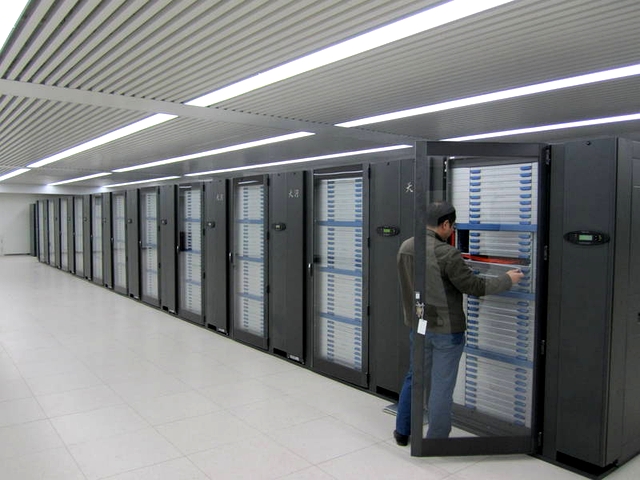 🇨🇳 ChinaTianhe-1
Chinese petascale supercomputer at the National Supercomputing Center in TianjinSupercomputer · Other Nvidia GPUs · 2009
🇨🇭 SwitzerlandPiz Daint
Swiss national supercomputer at CSCS, upgraded to Cray XC50/XC40 with Tesla P100 GPUsSupercomputer · Nvidia Ampere · 2012
 🇦🇺 AustraliaNational Computational Infrastructure
Australia's national high-performance computing and data facility at ANU in CanberraSupercomputer · Other Nvidia GPUs · 2007
 🇨🇳 ChinaTianhe-2
A 33.86-petaflops supercomputer in Guangzhou, built by NUDT with Inspur.Supercomputer · Other Nvidia GPUs · 2013
More from Sugon
All of them 🇺🇸 United StatesCloudflare
Edge network running Nvidia GPUs for AI inference via Workers AIInference platform · Other Nvidia GPUs · 2009
🇺🇸 United States and 2 moreDigitalOcean
Alternative cloud for developers, with GPU Droplets for AI workDeveloper cloud · Nvidia Hopper · 2011
🇮🇳 IndiaE2E Networks
India's listed GPU cloud for AI training and inference.Neocloud · Nvidia Hopper · 2009