Piz Daint
Swiss national supercomputer at CSCS, upgraded to Cray XC50/XC40 with Tesla P100 GPUs
Piz Daint is a supercomputer run by the Swiss National Supercomputing Centre and named after a peak in the Swiss Alps. Built by Cray and Hewlett Packard Enterprise, it entered service in 2012 and was expanded and upgraded in 2016, reaching 25 petaflops and third place worldwide on the TOP500 list that year.
- Installed December 2012 as a Cray XC30 at the Swiss National Supercomputing Centre
- 2016 upgrade tripled performance to 25 petaflops, reaching third place worldwide
- 25.326 PFLOPS on LINPACK, drawing 2.272 MW
- 8.7 petabytes of storage, running Linux (CLE)
- Ranked 20th on the TOP500 as of November 2021
What it is
Piz Daint is a supercomputer housed at the Swiss National Supercomputing Centre and named after a mountain in the Swiss Alps. Cray and Hewlett Packard Enterprise built the machine, which combines Intel Xeon E5-26xx processors with Nvidia Tesla P100 accelerators. It runs Linux on Cray's CLE environment and has 8.7 petabytes of storage. The system draws 2.272 megawatts and delivers 25.326 petaflops measured with LINPACK, the standard benchmark for ranking supercomputers. It serves as national research computing infrastructure in Switzerland rather than a commercial cloud service.
How it came about
The first Piz Daint, a Cray XC30, was installed in December 2012. A companion machine called Piz Dora, a Cray XC40 with 1,256 compute nodes, was added in 2013. In October 2016 the two were upgraded and merged into a single Cray XC50/XC40 system built around Nvidia Tesla P100 GPUs. That upgrade tripled performance to 25 petaflops and lifted the machine to third place worldwide. It has remained in service since, with a further upgrade noted in November 2016.
The compute
The current configuration pairs Intel Xeon E5-26xx (Haswell-EP) processors with Nvidia Tesla P100 GPU accelerators, giving the machine its hybrid CPU-GPU design. Storage totals 8.7 petabytes. Software is Linux, specifically Cray's CLE, a UNICOS-based environment. Measured LINPACK performance stands at 25.326 petaflops, with power consumption of 2.272 megawatts. The hardware comes from Cray, now part of Hewlett Packard Enterprise.
Where the GPUs are
All of the machine sits at the Swiss National Supercomputing Centre (CSCS) in Switzerland. The centre operates and owns the system. Power draw for the installation is 2.272 megawatts.
Its place in AI
Piz Daint has been a fixture near the top of the TOP500, the twice-yearly list of the world's fastest supercomputers. It held eighth place until the end of 2015, ahead of every other European machine. After the 2016 upgrade it ranked third globally. By November 2021 it stood 20th. Its GPU-accelerated design made it a reference system for hybrid CPU-GPU supercomputing in Europe.
Questions people ask about Piz Daint
What is Piz Daint?
A supercomputer at the Swiss National Supercomputing Centre, named after a peak in the Swiss Alps. Cray and Hewlett Packard Enterprise built it. It entered service in 2012 and was substantially upgraded in 2016, and it serves Swiss research computing.
How fast is it?
Its LINPACK performance is 25.326 petaflops, meaning it can carry out roughly 25 quadrillion floating-point operations per second on that benchmark. The 2016 upgrade tripled its earlier capability to about 25 petaflops.
What hardware does it use?
Intel Xeon E5-26xx processors of the Haswell-EP generation work alongside Nvidia Tesla P100 GPU accelerators. Storage totals 8.7 petabytes and the operating system is Linux, specifically Cray's CLE. Power consumption is 2.272 megawatts.
How does it rank against other supercomputers?
It placed eighth on the TOP500 list until the end of 2015, the highest of any European system at the time. After the 2016 upgrade it rose to third. As of November 2021 it ranked 20th.
Good reading and sources
The facts on this page come from the Wikipedia article "Piz Daint (supercomputer)", written by its contributors and used under the CC BY-SA 4.0 licence, and from its Wikidata record (CC0). EveryNeocloud rewrote the text in its own words, with AI assistance, and compares every page with the article to make sure no passage is copied. It may be reused under the same CC BY-SA 4.0 licence with a link back.
It may contain mistakes, and figures change over time. Nothing here is investment or buying advice. If something is wrong, tell us. Last refreshed 2026-11-14.
Like Piz Daint
All AI supercomputers 🇨🇳 ChinaTianhe-2
A 33.86-petaflops supercomputer in Guangzhou, built by NUDT with Inspur.Supercomputer · Other Nvidia GPUs · 2013
🇨🇳 ChinaNebulae
A petascale supercomputer in Shenzhen built by SugonSupercomputer · Other Nvidia GPUs · 2010
 🇮🇹 Italy and 1 moreGalileo
Italian national Tier-1 supercomputer for scientific and technical computingSupercomputer · Other Nvidia GPUs · 2015
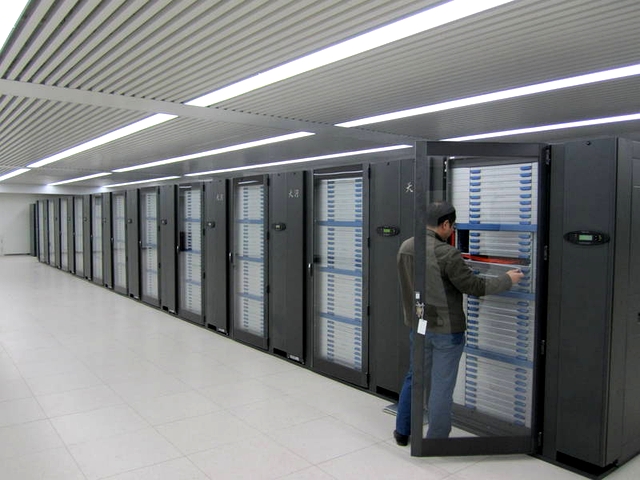 🇨🇳 ChinaTianhe-1
Chinese petascale supercomputer at the National Supercomputing Center in TianjinSupercomputer · Other Nvidia GPUs · 2009
More from Cray
All of them 🇺🇸 United StatesTitan
A hybrid supercomputer built by Cray for Oak Ridge National Laboratory.Supercomputer · Other Nvidia GPUs · 2012
🇯🇵 JapanUbitus
GPU virtualisation and cloud gaming company running AI compute centres across AsiaNeocloud · Other Nvidia GPUs · 2012
🇺🇸 United StatesLambda
AI-only GPU cloud running NVIDIA supercomputers for training and inferenceNeocloud · Nvidia Blackwell · 2012
🇺🇸 United States and 2 moreDigitalOcean
Alternative cloud for developers, with GPU Droplets for AI workDeveloper cloud · Nvidia Hopper · 2011