
Tianhe-2
A 33.86-petaflops supercomputer in Guangzhou, built by NUDT with Inspur.
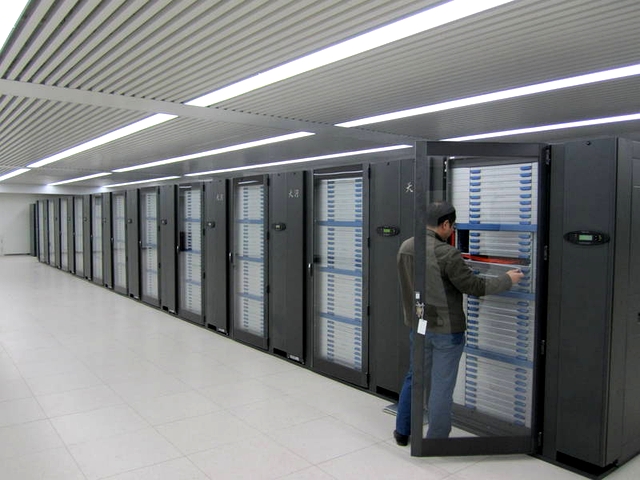
Tianhe-2 is a Chinese supercomputer housed at the National Supercomputer Center in Guangzhou and built by the National University of Defense Technology with Inspur. Declared operational in June 2013, it topped the TOP500 ranking for six consecutive lists and was designed for simulation, analysis and government security work.
- 33.86 petaflops measured performance
- Held the TOP500 number one spot from June 2013 to November 2015
- 16,000 nodes and 3,120,000 cores in the original configuration
- Build cost 2.4 billion Yuan (US$390,000,000)
- U.S. export licence refusal blocked a planned capacity doubling in 2015
What it is
Tianhe-2, also written TH-2, is a petascale supercomputer installed at the National Supercomputer Center in Guangzhou, China. The National University of Defense Technology (NUDT) led the build, working with the IT company Inspur. Its measured speed is 33.86 petaflops, meaning it can carry out roughly 33.86 quadrillion floating-point operations per second. The machine was put together by a team of 1,300 scientists and engineers. NUDT said the system would serve simulation, analysis and government security work. It runs on Kylin Linux, a NUDT variant, with Slurm handling job scheduling.
How it came about
The project was funded through the 863 High Technology Program, backed by the Chinese central government plus the Guangdong provincial and Guangzhou city authorities. Completion was originally planned for 2015, but the system was declared operational in June 2013, with full capability expected by the end of that year. It held the number one spot on the TOP500 list from June 2013 through November 2015, before Sunway TaihuLight took the record in June 2016. A planned capacity doubling with Sun Yat-sen University and local government was halted in 2015 when U.S. authorities refused Intel an export licence for the CPUs and coprocessor boards. That refusal led to the Tianhe-2A upgrade, swapping Xeon Phi parts for domestic Matrix-2000 accelerators.
The compute
The machine has 16,000 nodes, each with two Intel Ivy Bridge Xeon processors and three Xeon Phi coprocessor chips, giving 3,120,000 cores in total. The Tianhe-2A revision, using Matrix-2000 in place of Xeon Phi, reaches 4,981,760 cores. Memory per node is 88 GB, and combined CPU and coprocessor memory is 1,375 TiB. Storage is a 12.4 PiB H2FS file system with a 1 TiB/s burst rate, backed by Lustre at 100 GiB/s sustained. The front end uses 4,096 Galaxy FT-1500 SPARC-derived CPUs designed by NUDT. Networking is TH Express-2, a NUDT fat-tree design with 13 switches of 576 ports each.
Where the GPUs are
Tianhe-2 sits in the National Supercomputer Center in Guangzhou, southern China, and has been housed at NUDT. The completed complex occupies 720 square metres. At peak the system itself draws 17.6 megawatts, rising to 24 megawatts once external cooling is counted. Its southern location, with warmer average temperatures, adds roughly 10% to electricity use compared with a northern site.
Customers and deals
NUDT described the intended uses as simulation, analysis and government security applications. Sun Yat-sen University, together with Guangzhou district and city administrations, planned to double the machine's capacity before the plan was blocked. The system also served users writing scientific code, though some found the software work demanding.
Money and ownership
The build cost 2.4 billion Yuan, about US$390,000,000. Funding came through the 863 High Technology Program with support from the Chinese government, Guangdong province and Guangzhou city. Intel supplied the Xeon and Xeon Phi parts before the export licence refusal, and Inspur manufactured the printed circuit boards and assisted with installation and system software testing.
Its place in AI
Tianhe-2 returned the title of world's fastest supercomputer to China, following Tianhe-I's debut in November 2010. It beat second-placed Titan at Oak Ridge National Laboratory by close to two to one, 33.86 petaflops against 17.59. On the Graph500 benchmark it reached 2,061 gigaTEPS, and it led the HPCG benchmark with 0.580 PFLOPS in June 2014. China held 66 of the top 500 systems in June 2013, rising to 168 by June 2016.
Questions and criticism
Researchers said the machine was hard to use. Chi Xuebin of the Computer Network and Information Centre noted that while its calculation capacity led the world, its functionality lagged systems in the United States and Japan, and that some users would need years to write suitable code. The U.S. export licence refusal on Intel parts cut off planned upgrades and pushed the design towards domestic components. Its southern site also raises electricity use.
Questions people ask about Tianhe-2
What is Tianhe-2?
It is a Chinese supercomputer at the National Supercomputer Center in Guangzhou, built by the National University of Defense Technology with Inspur. Declared operational in June 2013, it measured 33.86 petaflops and was used for simulation, analysis and government security work.
Who built it and who paid?
NUDT led development with the IT firm Inspur, which made the printed circuit boards and helped install and test the system software. Funding came through the 863 High Technology Program, backed by the Chinese government, Guangdong province and Guangzhou city. The cost was 2.4 billion Yuan.
Why did the upgrade plans change?
In 2015 the U.S. government refused Intel an export licence for the CPUs and coprocessor boards needed to double capacity with Sun Yat-sen University. That led to Tianhe-2A, which replaced the Xeon Phi accelerators with domestic Matrix-2000 parts and raised the core count to 4,981,760.
What hardware does it use?
Each of 16,000 nodes holds two Intel Ivy Bridge Xeon processors and three Xeon Phi coprocessors. Memory totals 1,375 TiB, storage is 12.4 PiB, and the NUDT-designed TH Express-2 interconnect uses a fat-tree topology. The front end runs 4,096 Galaxy FT-1500 CPUs on Kylin Linux.
Good reading and sources
- US blocks Intel from selling Xeon chips to Chinese supercomputer projectsPCWorld, Article
- China's Tianhe-2 Caps Top 10 SupercomputersIEEE Spectrum, Article
The facts on this page come from the Wikipedia article "Tianhe-2", written by its contributors and used under the CC BY-SA 4.0 licence, and from its Wikidata record (CC0). EveryNeocloud rewrote the text in its own words, with AI assistance, and compares every page with the article to make sure no passage is copied. It may be reused under the same CC BY-SA 4.0 licence with a link back.
It may contain mistakes, and figures change over time. Nothing here is investment or buying advice. If something is wrong, tell us. Last refreshed 2026-11-14.
Like Tianhe-2
All AI supercomputers 🇮🇹 Italy and 1 moreGalileo
Italian national Tier-1 supercomputer for scientific and technical computingSupercomputer · Other Nvidia GPUs · 2015
🇨🇳 ChinaNebulae
A petascale supercomputer in Shenzhen built by SugonSupercomputer · Other Nvidia GPUs · 2010
 🇨🇳 ChinaTianhe-1
Chinese petascale supercomputer at the National Supercomputing Center in TianjinSupercomputer · Other Nvidia GPUs · 2009
More from National University of Defense Technology
All of them 🇨🇳 ChinaNational Supercomputer Center in Guangzhou
Guangzhou centre running the Tianhe-3 supercomputer for Chinese government useSupercomputer · 2014
🇱🇺 Luxembourg and 1 moreGcore
Luxembourg edge AI, cloud, CDN and security provider with GPU clusters in EuropeNeocloud · Other Nvidia GPUs · 2011
🇺🇸 United StatesSambaNova Systems
American provider of custom AI silicon and cloud inference services based on Reconfigurable Dataflow Units.Neocloud · Other and custom chips · 2017