Tianhe-1
Chinese petascale supercomputer at the National Supercomputing Center in Tianjin
Tianhe-1 is a supercomputer built by the National University of Defense Technology and installed at the National Supercomputing Center in Tianjin, China. First shown in October 2009 and upgraded as Tianhe-1A in October 2010, it held the TOP500 number one spot and runs workloads such as petroleum exploration and aircraft design.
- Held the TOP500 number one rank from November 2010 to June 2011
- Tianhe-1A reached 2,566 teraFLOPS Rmax and 4,701 teraFLOPS peak
- 7,168 Nvidia Tesla M2050 GPUs with 14,336 Xeon X5670 CPUs
- NUDT Arch interconnect runs at 160 Gbit/s, twice InfiniBand bandwidth
- Build cost $88 million; about $20 million a year to run
What it is
Tianhe-1 is a petascale supercomputer located at the National Supercomputing Center in Tianjin, China. The National University of Defense Technology developed it, and the centre operates it. The machine reached an Rmax of 2.5 petaFLOPS and was the fastest computer in the world between October 2010 and June 2011. Its main jobs are petroleum exploration and aircraft simulation and design. It runs a Linux-based operating system and is described as open access, offering services to users in other countries as well as domestic ones. The original system was later upgraded to Tianhe-1A, which raised both memory and speed considerably.
How it came about
NUDT, based in Changsha, Hunan, first showed Tianhe-1 on 29 October 2009. At the SC09 conference in Portland that November it entered the TOP500 list in fifth place, with 563 teraFLOPS measured and a 1.2 petaFLOPS peak, an efficiency of about 46%. An upgraded machine, Tianhe-1A, appeared at HPC 2010 China in October 2010 and took the top spot from Oak Ridge's Jaguar. The K computer passed it in mid-2011. In August 2015 the Tianjin explosions damaged the centre's office building; the machine itself was undamaged, some work was stopped as a precaution, and service restarted on 17 August 2015.
The compute
The first Tianhe-1 combined 4,096 Intel Xeon E5540 processors, 1,024 Xeon E5450 processors and 5,120 AMD GPUs built from 2,560 dual-chip ATI Radeon HD 4870 X2 cards. Tianhe-1A instead pairs 14,336 Xeon X5670 CPUs with 7,168 Nvidia Tesla M2050 GPUs across 3,584 blades, plus 2,048 FeiTeng 1000 SPARC processors on service and interconnect duties. Memory totals 262 terabytes and disk storage 2 petabytes on a Lustre clustered file system, with SLURM handling jobs. A NUDT-designed interconnect called Arch moves data at 160 Gbit/s, twice InfiniBand bandwidth.
Where the GPUs are
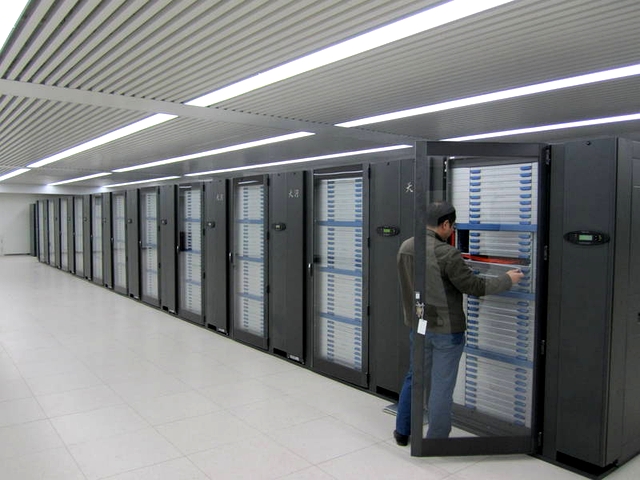
The system sits in the National Supercomputing Center in Tianjin. Tianhe-1A fills 112 computer cabinets, along with 12 for storage, 6 for communications and 8 for input and output. Each computer cabinet holds four frames of eight blades plus a switching board. The heterogeneous design draws 4.04 megawatts, against more than 12 megawatts for a CPU-only build of the same speed. Around 200 staff keep it running.
Customers and deals
The centre uses the machine for petroleum exploration and aircraft design work. It is open access, so it takes jobs from other countries too and is available to international clients. In June 2011 researchers at the Institute of Process Engineering, Chinese Academy of Sciences, ran a molecular dynamics simulation for solar energy research across all 7,168 Nvidia Tesla GPUs, reaching 1.87 petaFLOPS.
Money and ownership
Building Tianhe-1A cost $88 million. Running it, including electricity, comes to roughly $20 million each year. Nvidia has noted that matching its performance with CPUs alone would have needed about 50,000 processors and twice the floor space.
Its place in AI
Tianhe-1A topped the TOP500 ranking from November 2010 until the K computer took over in 2011, making China the third country after the United States and Japan to build the world's fastest computer. It was among the small group of petascale systems then in existence. The CAS-IPE simulation on it was reported as a record-breaking molecular dynamics run.
Questions and criticism
The centre sits close to the site of the August 2015 Tianjin explosions, which damaged its office building and forced a temporary shutdown. The machine itself was reported undamaged. The large annual electricity and operating bill is a continuing cost.
Questions people ask about Tianhe-1
What is Tianhe-1?
A petascale supercomputer at the National Supercomputing Center in Tianjin, China, developed by the National University of Defense Technology. It was first shown in October 2009 and upgraded to Tianhe-1A a year later. Its work includes petroleum exploration and aircraft design.
How fast is it?
Tianhe-1A measures 2,566 teraFLOPS on LINPACK (Rmax) with a theoretical peak of 4,701 teraFLOPS, or about 2.5 petaFLOPS. The earlier Tianhe-1 reached 563 teraFLOPS measured and 1,206.2 teraFLOPS peak.
What hardware does it use?
Tianhe-1A pairs 14,336 Intel Xeon X5670 processors with 7,168 Nvidia Tesla M2050 GPUs, plus FeiTeng 1000 SPARC chips. It has 262 terabytes of memory, 2 petabytes of Lustre storage and a NUDT interconnect called Arch running at 160 Gbit/s.
Who can use it?
It is described as open access, serving users beyond China as well as domestic ones. Around 200 staff operate it, and it has run work for the Chinese Academy of Sciences among others.
Good reading and sources
- China's super computer Tianhe-1 re-started after Tianjin blastsThe Economic Times, Article
- China Wrests Supercomputer Title From U.S. (Published 2010)The New York Times, Article
The facts on this page come from the Wikipedia article "Tianhe-1", written by its contributors and used under the CC BY-SA 4.0 licence, and from its Wikidata record (CC0). EveryNeocloud rewrote the text in its own words, with AI assistance, and compares every page with the article to make sure no passage is copied. It may be reused under the same CC BY-SA 4.0 licence with a link back.
It may contain mistakes, and figures change over time. Nothing here is investment or buying advice. If something is wrong, tell us. Last refreshed 2026-11-14.
Like Tianhe-1
All AI supercomputers 🇯🇵 JapanTsubame
A long-running Japanese supercomputer series built for AI and scientific computing.Supercomputer · Nvidia Hopper · 2006
🇨🇳 ChinaNebulae
A petascale supercomputer in Shenzhen built by SugonSupercomputer · Other Nvidia GPUs · 2010
 🇦🇺 AustraliaNational Computational Infrastructure
Australia's national high-performance computing and data facility at ANU in CanberraSupercomputer · Other Nvidia GPUs · 2007
🇨🇭 SwitzerlandPiz Daint
Swiss national supercomputer at CSCS, upgraded to Cray XC50/XC40 with Tesla P100 GPUsSupercomputer · Nvidia Ampere · 2012
More from National University of Defense Technology
All of them 🇺🇸 United StatesCloudflare
Edge network running Nvidia GPUs for AI inference via Workers AIInference platform · Other Nvidia GPUs · 2009
🇮🇳 IndiaE2E Networks
India's listed GPU cloud for AI training and inference.Neocloud · Nvidia Hopper · 2009
🇺🇸 United States and 2 moreDigitalOcean
Alternative cloud for developers, with GPU Droplets for AI workDeveloper cloud · Nvidia Hopper · 2011
🇱🇺 Luxembourg and 1 moreGcore
Luxembourg edge AI, cloud, CDN and security provider with GPU clusters in EuropeNeocloud · Other Nvidia GPUs · 2011