
Tsubame
A long-running Japanese supercomputer series built for AI and scientific computing.
Tsubame is a line of supercomputers run at the GSIC Center of the Institute of Science Tokyo, previously at Tokyo Institute of Technology. Designed by Satoshi Matsuoka, the series has been rebuilt several times since 2006 and now runs Tsubame 4.0, a large GPU system aimed at AI work.
- First system started in 2006 at 85 TFLOPS, leading Japan and Asia
- Tsubame 2.0 peaked at 2,288 TFLOPS with 4,200 Nvidia Tesla M2050 modules
- Tsubame-KFC hit 4.5 gigaflops per watt using oil liquid cooling
- Tsubame 3.0 topped the June 2017 Green500 at 14.110 GFLOPS/watts
- Tsubame 4.0 runs 960 Nvidia H-100 GPUs and about 66.8 PFLOPS
What it is
Tsubame is a family of supercomputers housed at the GSIC Center within the Institute of Science Tokyo. The line began with a machine switched on in 2006 and has been replaced or upgraded repeatedly since. Satoshi Matsuoka designed the series. Each generation mixes general-purpose processors with accelerators, and the newest, Tsubame 4.0, went live in June 2024 with a strong focus on artificial intelligence work. The system serves research rather than commercial cloud rental.
How it came about
The first machine, put together by Sun Microsystems, started in 2006 and reached 85 TFLOPS, leading Japan and Asia at that moment. A 2008 upgrade added Nvidia Tesla hardware and lifted output to 170 TFLOPS. HP and NEC delivered a replacement in 2010, and a further refresh in 2014 swapped in Kepler K20x parts. An oil-cooled variant called Tsubame-KFC pushed efficiency records. SGI helped build a 2017 AI-focused system, and HP delivered the current machine in 2024.
The compute
Early nodes used dual-core AMD Opteron chips linked over InfiniBand, plus ClearSpeed accelerator cards. Later versions leaned heavily on Nvidia GPUs: Tesla T10, then M2050, then Kepler K20x, then P100. The 2024 machine pairs two 96-core AMD EPYC 9654 processors per node with four Nvidia H-100 GPUs and 768 GiB of DDR5 memory. Memory totals across older systems included 80.6 TB of DRAM plus GPU-side GDDR.
Where the GPUs are
All versions sit at the GSIC Center in Tokyo. The operator changed in October 2024 when the Institute of Science Tokyo was founded, taking over from Tokyo Institute of Technology. Tsubame 4.0 is the first in the series run by the new body.
Its place in AI
The series has repeatedly placed on the TOP500 ranking of the world's fastest machines. Tsubame 2.0 reached a high position on the November 2010 list and led Japan. Tsubame 3.0 appeared on the November 2017 list and topped the June 2017 Green500 efficiency table at 14.110 GFLOPS per watt. Tsubame 4.0 entered the November 2024 TOP500 at 36th worldwide and 5th within Japan.
Questions and criticism
Power use has been a design concern. The Tsubame-KFC variant used oil-based liquid cooling to cut consumption and reached 4.5 gigaflops per watt, described at the time as the best efficiency figure worldwide.
Questions people ask about Tsubame
What is Tsubame?
It is a series of supercomputers operated at the GSIC Center of the Institute of Science Tokyo. The line started in 2006 and has been rebuilt several times, with the current version running since June 2024 and aimed at AI work.
Who builds these machines?
Different vendors handled each generation. Sun Microsystems built the first, HP and NEC delivered the 2010 replacement, SGI worked on the 2017 system, and HP produced Tsubame 4.0. Satoshi Matsuoka designed the series.
What hardware does the newest system use?
Tsubame 4.0 has 240 nodes. Each node carries two 96-core AMD EPYC 9654 processors, 768 GiB of DDR5-4800 memory and four Nvidia H-100 GPUs, giving roughly 66.8 PFLOPS in double precision.
How has it ranked internationally?
Tsubame 2.0 reached a high mark on the November 2010 TOP500 and led Japan. Tsubame 3.0 placed 13th in November 2017 and led the June 2017 Green500. Tsubame 4.0 ranked 36rd worldwide on the November 2024 list.
Good reading and sources
- Submerged Supercomputer Named WorldData Center Knowledge, Article
- Nvidia To Power JapanTom's Hardware, Article
The facts on this page come from the Wikipedia article "Tsubame (supercomputer)", written by its contributors and used under the CC BY-SA 4.0 licence, and from its Wikidata record (CC0). EveryNeocloud rewrote the text in its own words, with AI assistance, and compares every page with the article to make sure no passage is copied. It may be reused under the same CC BY-SA 4.0 licence with a link back.
It may contain mistakes, and figures change over time. Nothing here is investment or buying advice. If something is wrong, tell us. Last refreshed 2026-11-14.
Like Tsubame
All AI supercomputers 🇪🇸 Spain and 1 moreMareNostrum
Spain's main supercomputer at the Barcelona Supercomputing CenterSupercomputer · Nvidia Hopper · 2005
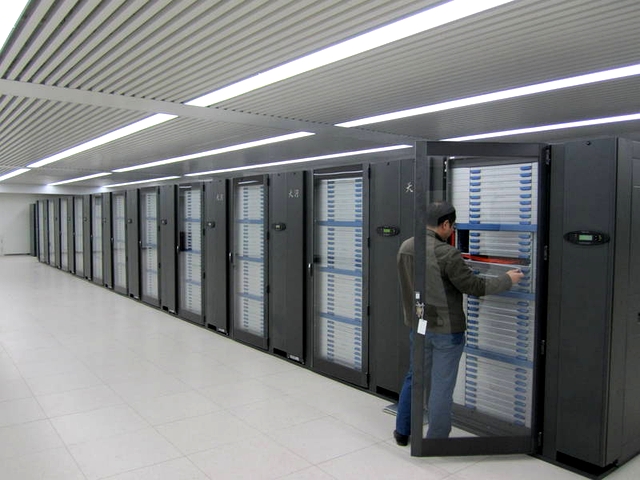 🇨🇳 ChinaTianhe-1
Chinese petascale supercomputer at the National Supercomputing Center in TianjinSupercomputer · Other Nvidia GPUs · 2009
 🇪🇸 SpainBarcelona Supercomputing Center
Spanish national supercomputing centre running the MareNostrum machine in BarcelonaResearch cluster · Other Nvidia GPUs · 2005
 🇦🇺 AustraliaNational Computational Infrastructure
Australia's national high-performance computing and data facility at ANU in CanberraSupercomputer · Other Nvidia GPUs · 2007
More from Tokyo Institute of Technology
All of them 🇯🇵 JapanEarth Simulator
Japanese vector supercomputer series built for global climate and solid earth simulation.Supercomputer · Other and custom chips · 2002
🇨🇭 SwitzerlandPiz Daint
Swiss national supercomputer at CSCS, upgraded to Cray XC50/XC40 with Tesla P100 GPUsSupercomputer · Nvidia Ampere · 2012
 🇩🇪 GermanyHigh Performance Computing Center, Stuttgart
University of Stuttgart supercomputer centre running the Hawk systemSupercomputer · 1995
🇱🇺 Luxembourg and 4 moreEuroHPC Joint Undertaking
EU public-private partnership building a pan-European supercomputing and AI infrastructureSupercomputer · Other and custom chips · 2018