
Titan
A hybrid supercomputer built by Cray for Oak Ridge National Laboratory.
Titan was a supercomputer constructed by Cray at Oak Ridge National Laboratory. It operated from 2012 to 2019 and served as an upgrade to the Jaguar system. The machine combined CPUs with GPUs to achieve high performance for scientific research.
- First supercomputer to exceed 10 petaFLOPS using GPUs.
- Ranked number one on TOP500 in November 2012.
- Used 18,688 Nvidia Tesla K20X GPUs.
- Operational from October 2012 to August 2019.
- Cost US$97 million including the full Cray contract.
What it is
Titan, also known as OLCF-3, was a supercomputer located at Oak Ridge National Laboratory in the United States. Built by Cray, it replaced the earlier Jaguar system. The machine used a hybrid design that paired AMD Opteron CPUs with Nvidia Tesla GPUs. This combination allowed it to perform over 10 petaFLOPS, making it the first system of its kind to reach that speed. It became operational in late 2012 and was decommissioned in August 2019.
How it came about
Plans for Titan began around 2005, following the construction of Jaguar. A deal with Nvidia for GPUs was signed in 2009. The physical upgrade started in October 2011, reusing Jaguar's cabinets to save costs. Stability testing occurred in October 2012, and researchers gained access in early 2013. Funding came mainly from the US Department of Energy, with NOAA contributing less than $10 million. The project faced delays due to hardware defects in motherboard connectors, which required repairs throughout 2013.
The compute
The system contained 18,688 nodes, each with a 16-core AMD Opteron CPU and an Nvidia Tesla K20X GPU. It had 693.6 TiB of memory and 40 PB of storage using a Lustre filesystem. The theoretical peak performance was 27 petaFLOPS, while LINPACK benchmarks recorded 17.59 petaFLOPS. It ran the Cray Linux Environment and used a Gemini interconnect network. Researchers had to modify their code to utilize the parallel processing capabilities of the GPUs effectively.
Where the GPUs are
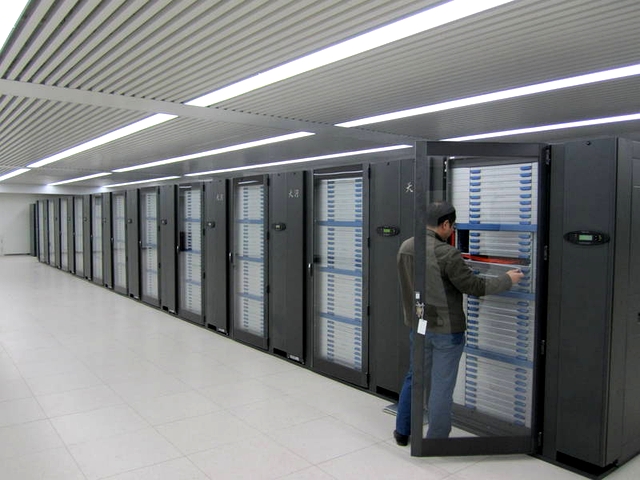
Titan was housed in the existing infrastructure of Oak Ridge National Laboratory. The machine occupied 404 square meters across 200 cabinets. Power was supplied via three-phase 480 V lines, drawing up to 8.2 MW. Cooling involved chilling water to 5.5 °C to manage heat from the components. Backup power relied on diesel generators and carbon fiber flywheels to maintain networking during outages.
Customers and deals
Access was granted to scientific projects deemed important enough to exploit the hybrid architecture. Six vanguard programs were selected initially, focusing on molecular physics and climate models. Users had to ensure their software could run on other systems to avoid dependency. Projects like S3D, Denovo, and LAMMPS utilized the machine for simulations ranging from combustion to nuclear reactions.
Money and ownership
The initial upgrade cost was approximately US$60 million. The total contract with Cray reached US$97 million. The US Department of Energy provided primary funding. NOAA contributed under $10 million in exchange for computing time. Reusing Jaguar's building and cooling systems saved about $20 million. Thinner cables due to higher voltage saved another $1 million in copper costs.
Its place in AI
Titan ranked first on the TOP500 list in November 2012. It later fell to second place behind Tianhe-2 in June 2013. It also appeared on the Green500 list for energy efficiency. The system was succeeded by Summit in 2019. Titan demonstrated the viability of GPU-accelerated computing for large-scale scientific problems. Its legacy includes enabling faster simulations for materials science and astrophysics.
Questions and criticism
The system required significant code modifications to run efficiently on GPUs. Some researchers found adapting their applications difficult compared to CPU-only machines. Hardware issues with motherboard connectors caused acceptance test delays. The loud fan noise required hearing protection for staff in the machine room. The reliance on specific vendor architectures raised questions about long-term software portability.
Questions people ask about Titan
What made Titan different from previous supercomputers?
Titan was a hybrid system that combined traditional CPUs with graphics processing units. This design improved energy efficiency and computational power significantly compared to CPU-only machines like its predecessor, Jaguar.
Who funded the construction of Titan?
The United States Department of Energy provided the majority of the funding. The National Oceanic and Atmospheric Administration contributed less than $10 million in exchange for dedicated computing time on the system.
Why did Titan require code modifications?
Researchers had to adapt their software to utilize the parallel processing capabilities of the GPUs. While this increased performance, it required changes to how tasks were allocated and executed compared to standard CPU-based programming.
Good reading and sources
- Titan (supercomputer) on WikipediaEncyclopedia
- More photos on Wikimedia CommonsPhotos
- Wikidata recordOpen data
The facts on this page come from the Wikipedia article "Titan (supercomputer)", written by its contributors and used under the CC BY-SA 4.0 licence, and from its Wikidata record (CC0). EveryNeocloud rewrote the text in its own words, with AI assistance, and compares every page with the article to make sure no passage is copied. It may be reused under the same CC BY-SA 4.0 licence with a link back.
It may contain mistakes, and figures change over time. Nothing here is investment or buying advice. If something is wrong, tell us. Last refreshed 2026-11-17.
Like Titan
All AI supercomputers 🇺🇸 United StatesSummit
A supercomputer built by IBM for the Oak Ridge National Laboratory.Supercomputer · Other Nvidia GPUs · 2018
 🇨🇳 ChinaTianhe-1
Chinese petascale supercomputer at the National Supercomputing Center in TianjinSupercomputer · Other Nvidia GPUs · 2009
 🇯🇵 JapanTsubame
A long-running Japanese supercomputer series built for AI and scientific computing.Supercomputer · Nvidia Hopper · 2006
🇹🇼 TaiwanTaiwania
A series of supercomputers in Taiwan for scientific research and public access.Supercomputer · Other Nvidia GPUs · 2018