
MareNostrum
Spain's main supercomputer at the Barcelona Supercomputing Center
MareNostrum is the flagship supercomputer of the Barcelona Supercomputing Center, first booted on 12 April 2005 and repeatedly rebuilt since. The current MareNostrum 5 generation became operational in December 2023 as a EuroHPC pre-exascale host, serving science across Spain and Europe.
- First booted 12 April 2005 in a deconsecrated chapel in Barcelona
- Most powerful supercomputer in Spain and a PRACE anchor system
- MareNostrum 4 cost €34 million and reached 30th on TOP500 in November 2019
- Current machine: 314 PFlops, 1.6 PB memory, 248 PB storage, 1.3 MW
- MareNostrum 5 went live December 2023 after a delay from 2020
What it is
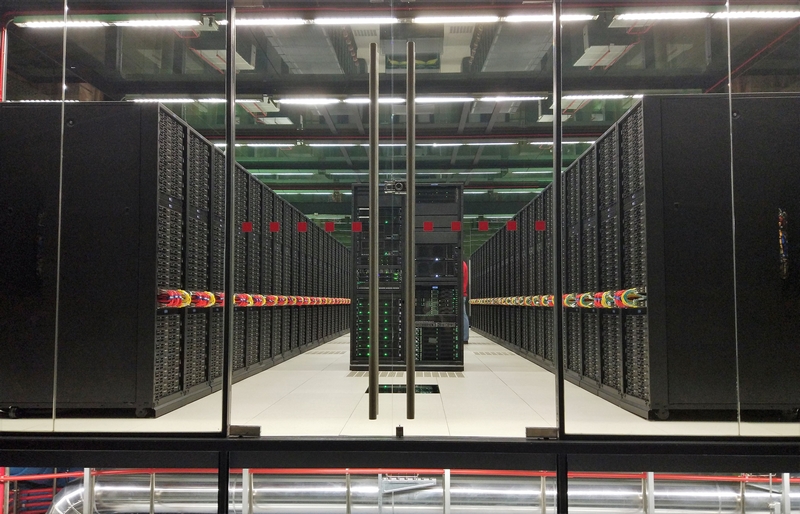
MareNostrum is the principal supercomputer of the Barcelona Supercomputing Center in Spain. It ranks as the country's strongest machine, sits inside the Spanish Supercomputing Network of thirteen systems, and serves as one of seven computers in the European PRACE infrastructure. The installation fills 180 square metres, less than half a basketball court, and runs Red Hat Enterprise Linux. Its current configuration combines Bull Sequana XH3000 and Lenovo ThinkSystem designs, with Intel Sapphire Rapids, Nvidia Grace ARM CPUs and Nvidia Hopper GPUs. Memory totals 1.6 petabytes and storage 248 petabytes, with a rated speed of 314 PFlops drawing 1.3 MW. Scientists across Spain and abroad book time on it.
How it came about
The machine first booted on 12 April 2005. MareNostrum 2 used 2,560 IBM BladeCenter JS21 nodes with PowerPC 970MP chips and 20 TB of memory. MareNostrum 3 followed with 3,056 IBM iDataPlex DX360M4 nodes, 48,896 Intel Sandy Bridge cores and 84 Xeon Phi 5110P cards. MareNostrum 4 arrived with a €34 million price tag and a TOP500 position of 30 in November 2019. In July 2019 the EuroHPC Joint Undertaking picked BSC to host a pre-exascale system. That machine, MareNostrum 5, slipped from a planned end-2020 date and went live in December 2023.
The compute
MareNostrum 4 split into a general-purpose block and an emerging-technologies block. The general part held 48 racks of 3,456 Lenovo ThinkSystem SD530 nodes, each carrying two 24-core Intel Xeon Platinum chips, giving 165,888 cores and 390 terabytes of RAM at 11.15 petaflops peak. An Omni-Path fabric linked everything. Experimental clusters mixed IBM POWER9 with Nvidia Volta GPUs, AMD Rome with Radeon Instinct MI50, and 64-bit ARMv8 prototypes. MareNostrum 3 nodes talked over InfiniBand FDR10 with Mellanox switches plus Gigabit Ethernet. Five storage racks held 14 petabytes, tied to BSC big-data stores of 24.6 petabytes.
Where the GPUs are
The computer sits in the deconsecrated Chapel Torre Girona at the Polytechnic University of Catalonia in Barcelona. MareNostrum 4 drew 1.3 MW, only 30% more than MareNostrum 3 despite ten times the performance. Links to European research centres and universities run over the RedIRIS and GÉANT networks. The current machine spans 180 square metres.
Customers and deals
Time on MareNostrum is open to the national and international scientific community. Work covers human genome research, protein studies, astrophysical simulations, weather forecasting, geological and geophysical modelling, and drug design. Other projects address air quality, aerosols, smart cities, clinical data, cardiovascular and respiratory simulation, agriculture and water management, ocean forecasting, tropical cyclones, wind turbine siting, earthquake simulation, fluid mechanics, cultural evolution and public safety.
Money and ownership
MareNostrum 4 cost €34 million. The EuroHPC Joint Undertaking, backed by the European Commission, selected BSC in July 2019 to host a pre-exascale machine in the European high-capacity network.
Its place in AI
MareNostrum is the most powerful supercomputer in Spain and a node of PRACE, the Partnership for Advanced Computing in Europe. Its emerging-technology block let BSC trial designs tied to the US Summit and Sierra machines and Japan's Post-K project before they reached the wider market. MareNostrum 5 adds an experimental platform for testing European supercomputing technology. The name is the Roman term for the Mediterranean Sea.
Questions and criticism
The MareNostrum 5 deployment slipped from its expected 31 December 2020 start to December 2023. Power for MareNostrum 4 rose 30% over its predecessor even as compute grew tenfold.


Questions people ask about MareNostrum
What is MareNostrum?
It is the main supercomputer of the Barcelona Supercomputing Center, the strongest in Spain and part of both the Spanish Supercomputing Network and the European PRACE infrastructure. Scientists in Spain and abroad use it for research.
Where does it live?
The machine occupies 180 square metres inside the deconsecrated Chapel Torre Girona at the Polytechnic University of Catalonia in Barcelona. It runs Red Hat Enterprise Linux.
What is it used for?
Genome and protein research, astrophysics, weather forecasting, geology, drug design, air quality, climate prediction, biomechanics, big data, engineering simulation and social simulation all run on it.
How is MareNostrum 5 different?
Selected by EuroHPC in July 2019 as a pre-exascale host, it entered service in December 2023 after a delay. It uses Intel Sapphire Rapids, Nvidia Grace CPUs and Hopper GPUs, and includes a platform for testing European supercomputing technology.
Good reading and sources
- Official websiteOfficial site
- MareNostrum - iDataPlex DX360M4, Xeon E5-2670 8C 2.600GHz, Infiniband FDRTOP500, Article
The facts on this page come from the Wikipedia article "MareNostrum", written by its contributors and used under the CC BY-SA 4.0 licence, and from its Wikidata record (CC0). EveryNeocloud rewrote the text in its own words, with AI assistance, and compares every page with the article to make sure no passage is copied. It may be reused under the same CC BY-SA 4.0 licence with a link back.
It may contain mistakes, and figures change over time. Nothing here is investment or buying advice. If something is wrong, tell us. Last refreshed 2026-11-14.
Like MareNostrum
All AI supercomputers 🇯🇵 JapanTsubame
A long-running Japanese supercomputer series built for AI and scientific computing.Supercomputer · Nvidia Hopper · 2006
 🇨🇳 ChinaTianhe-1
Chinese petascale supercomputer at the National Supercomputing Center in TianjinSupercomputer · Other Nvidia GPUs · 2009
🇵🇹 PortugalDeucalion
Portugal's fastest supercomputer, hosted at MACC in GuimarãesSupercomputer · Nvidia Ampere · 2023
 🇫🇮 Finland and 3 moreLUMI
EuroHPC petascale machine in Kajaani, Finland, built by HPE on AMD hardwareSupercomputer · AMD Instinct · 2023
More from Barcelona Supercomputing Center
All of them 🇪🇸 SpainBarcelona Supercomputing Center
Spanish national supercomputing centre running the MareNostrum machine in BarcelonaResearch cluster · Other Nvidia GPUs · 2005
 🇺🇸 United StatesNCAR-Wyoming Supercomputing Center
A high-performance computing and data archival facility in Cheyenne, Wyoming.Supercomputer · Other Nvidia GPUs · 2003
 🇪🇸 SpainSpanish Supercomputing Network
Spain's linked supercomputers offering free HPC time to research groupsSupercomputer · 2007
 🇺🇸 United StatesRoadrunner
IBM-built hybrid supercomputer at Los Alamos, first to sustain a petaflopSupercomputer · Other and custom chips · 2008