
Roadrunner
IBM-built hybrid supercomputer at Los Alamos, first to sustain a petaflop
Roadrunner was a one-off supercomputer assembled by IBM for the Los Alamos National Laboratory in New Mexico, running from 2008 until its shutdown in 2013. It mixed AMD Opteron server chips with IBM PowerXCell 8i accelerators, and in May 2008 became the first machine to sustain a petaflop on the TOP500 LINPACK benchmark.
- First TOP500 system to sustain 1.0 petaflops on LINPACK, on 25 May 2008
- 12,960 IBM PowerXCell 8i processors paired with 6,480 AMD Opteron chips
- 296 racks, 560 square metres, drawing 2.35 MW at Los Alamos
- Fourth on the Green500 list at 444.94 megaflops per watt
- Switched off 31 March 2013 and replaced by Cielo
What it is
Roadrunner was a single supercomputer built by IBM and installed at Los Alamos National Laboratory in New Mexico for the U.S. National Nuclear Security Administration. It cost US$100 million and was designed to peak at 1.7 petaflops. The machine filled 296 racks over 560 square metres and drew 2.35 MW. Its main job was modelling how nuclear materials age, so that the United States could judge whether its ageing weapons remained safe and reliable. Time on the system also went to work in science, finance, automotive engineering and aerospace. In June 2011 it sat at number 10 on the TOP500 ranking.
How it came about
Work on Roadrunner began in 2002 and the first hardware came online in 2006. Because the design was unusual and hard to program, IBM built it in three stages. Phase 1 was an ordinary Opteron cluster that reached 71 teraflops in 2006. Phase 2, called AAIS, was a small hybrid testbed using an earlier Cell chip and started in January 2007. Phase 3 added Opteron nodes and the newer PowerXCell 8i parts, five times stronger than the Phase 2 chips. Full-scale assembly happened at IBM's Poughkeepsie site in New York, and the finished machine moved to New Mexico in summer 2008.
The compute
The design paired AMD Opteron 2210 dual-core server chips at 1.8 GHz with IBM PowerXCell 8i processors at 3.2 GHz. Each PowerXCell carried one general-purpose core and eight floating-point cores. In total there were 6,912 Opterons (13,824 cores) and 12,960 PowerXCell chips (116,640 cores), split across 51.8 TiB of Opteron memory and 51.8 TiB of Cell memory. Blades were grouped into TriBlade units, then into Connected Units of 180 TriBlades, and finally 18 Connected Units linked by Voltaire ISR2012 InfiniBand 4x DDR switches. Storage ran on a Panasas file system. Software was Red Hat Enterprise Linux with Fedora, xCAT management and Open MPI.
Where the GPUs are
The machine lived at Los Alamos National Laboratory in New Mexico, spread over 296 racks and 560 square metres. It drew 2.35 MW in operation. Assembly of the full-scale system took place at IBM's Poughkeepsie facility in New York before the hardware was shipped west in the summer of 2008. Los Alamos ran the machine for the National Nuclear Security Administration until it was switched off on 31 March 2013.
Customers and deals
The paying customer was the U.S. Department of Energy's National Nuclear Security Administration, which used Roadrunner to simulate ageing in nuclear materials and check the condition of the country's weapons stockpile. Spare capacity served problems in science, finance, automotive design and aerospace. IBM both built the system and sponsored it.
Money and ownership
The build cost was US$100 million in 2008 terms. IBM sponsored the project and the U.S. Department of Energy funded the work through the National Nuclear Security Administration. No revenue, valuation or debt figures are recorded here.
Its place in AI
Roadrunner's claim to fame is a benchmark result: on 25 May 2008 it became the first TOP500 system to sustain 1.0 petaflops on LINPACK, scoring 1.026. By November 2008 it had reached 1.456 petaflops and held the top of the TOP500 list. It also placed fourth on the Green500 efficiency table at 444.94 megaflops per watt. Its hybrid Opteron-plus-Cell approach was copied by later energy-conscious machines. Los Alamos replaced it with Cielo, installed in 2010.
Questions and criticism
Efficiency was the weak point. Roadrunner managed about 444 megaflops per watt where a comparable machine of the time reached 886, and that gap helped prompt the shutdown. The hybrid architecture also demanded software written specifically for it. Because much of the work was classified, Los Alamos oversaw the dismantling itself, shredding the electronics and keeping only some parts for historical record.


Questions people ask about Roadrunner
What was Roadrunner for?
It was built for the U.S. National Nuclear Security Administration at Los Alamos National Laboratory. Its main task was modelling how nuclear materials age, to judge whether the country's ageing weapons stayed safe and reliable. Other work covered science, finance, automotive and aerospace problems.
Why was the design unusual?
It mixed two processor types: AMD Opteron server chips handling data and system work, with IBM PowerXCell 8i chips attached for heavy floating-point maths. That hybrid approach dated back to ideas from Seymour Cray, but meant all software had to be written specifically for the machine.
How fast was it?
It was designed for a 1.7 petaflop peak. On 25 May 2008 it became the first TOP500 machine to sustain a petaflop on LINPACK, scoring 1.026. By November 2008 it reached 1.456 petaflops and still led the TOP500 list.
What happened to it?
Los Alamos shut Roadrunner down on 31 March 2013, largely because of its poor energy efficiency. Researchers spent a month running memory and routing experiments first. The electronics were then shredded, with Los Alamos handling the destruction because of the classified nature of the calculations, though some parts were kept for history.
Good reading and sources
- Official websiteOfficial site
- BBC NEWS | TechnologyBBC, Article
- World’s top supercomputer from ‘09 is now obsolete, will be dismantledArs Technica, Article
- Roadrunner (supercomputer) on WikipediaEncyclopedia
- More photos on Wikimedia CommonsPhotos
- Wikidata recordOpen data
The facts on this page come from the Wikipedia article "Roadrunner (supercomputer)", written by its contributors and used under the CC BY-SA 4.0 licence, and from its Wikidata record (CC0). EveryNeocloud rewrote the text in its own words, with AI assistance, and compares every page with the article to make sure no passage is copied. It may be reused under the same CC BY-SA 4.0 licence with a link back.
It may contain mistakes, and figures change over time. Nothing here is investment or buying advice. If something is wrong, tell us. Last refreshed 2026-11-14.
Like Roadrunner
All AI supercomputers 🇦🇺 AustraliaNational Computational Infrastructure
Australia's national high-performance computing and data facility at ANU in CanberraSupercomputer · Other Nvidia GPUs · 2007
🇸🇦 Saudi Arabia and 1 moreShaheen
KAUST's flagship supercomputer series in Saudi ArabiaSupercomputer · Other and custom chips · 2009
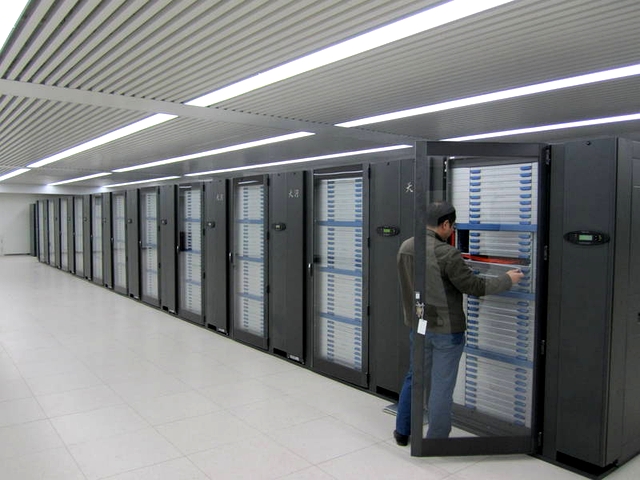 🇨🇳 ChinaTianhe-1
Chinese petascale supercomputer at the National Supercomputing Center in TianjinSupercomputer · Other Nvidia GPUs · 2009
🇨🇳 ChinaNebulae
A petascale supercomputer in Shenzhen built by SugonSupercomputer · Other Nvidia GPUs · 2010
More from IBM
All of them 🇺🇸 United StatesCloudflare
Edge network running Nvidia GPUs for AI inference via Workers AIInference platform · Other Nvidia GPUs · 2009
🇳🇱 Netherlands and 3 moreHostkey
Dedicated GPU and bare-metal server provider in Europe and the USNeocloud · Other Nvidia GPUs · 2007
 🇪🇸 Spain and 1 moreMareNostrum
Spain's main supercomputer at the Barcelona Supercomputing CenterSupercomputer · Nvidia Hopper · 2005
 🇪🇸 SpainBarcelona Supercomputing Center
Spanish national supercomputing centre running the MareNostrum machine in BarcelonaResearch cluster · Other Nvidia GPUs · 2005