
Texas Advanced Computing Center
University of Texas centre running supercomputers and storage for U.S. research
The Texas Advanced Computing Center is an advanced computing research centre at the University of Texas at Austin, founded in 2001 and based on the J. J. Pickle Research Campus. It builds and runs high-performance computing, visualisation and storage systems for researchers in Texas and nationwide, and takes part in national programmes such as XSEDE.
- Founded in 2001 at the University of Texas at Austin
- Stampede reached 9.6 petaflops across 6,400 nodes
- Stampede ranked 6th on the June 2013 Top500 list
- Ranch tape archive holds 40 PB of offline storage
- Part of the Federal Reserve's BigTex cluster came from Stampede
What it is
The Texas Advanced Computing Center (TACC) is a research centre at the University of Texas at Austin. It designs, deploys and operates advanced computing infrastructure for researchers at UT Austin and across the United States. Its work covers high-performance computing, scientific visualisation, data analysis, storage, software and portal interfaces, and it also offers consulting, documentation and training. TACC runs a series of large clusters and storage systems, including Stampede, Lonestar, Maverick, Ranch and Corral, on the J. J. Pickle Research Campus. Through national programmes, its resources reach the wider American academic community. Staff also carry out research on applications, algorithms, system architecture and programming tools.
How it came about
TACC was founded in 2001 and grew into one of the country's centres of computational excellence. Its systems were funded through federal programmes, notably National Science Foundation awards, and built with industry partners such as Intel, Dell and Mellanox. The Lonestar line of clusters went through several generations from the early 2000s, and Stampede came online in January 2013. XSEDE, the national resource-sharing project TACC helped run, ended formal NSF-funded operations on 31 August 2022, with similar services continuing under the follow-on ACCESS programme.
The compute
TACC's machines mix CPUs, coprocessors and GPUs. Stampede paired dual Xeon E5-2680 processors with Xeon Phi coprocessors across 6,400 nodes, plus 128 nodes carrying Nvidia Kepler K20 GPUs, reaching 9.6 petaflops. Maverick used 132 Nvidia Tesla K40 GPUs for remote visualisation and GPU computing, linked by Mellanox FDR InfiniBand to a 20 PB file system. Lonestar 4 offered 22,656 Intel Xeon cores, a 1,000 TB Lustre scratch file system and eight GPU nodes. Storage spans the Ranch tape archive, with 40 PB offline capacity, and Corral's 6 PB of online disk.
Where the GPUs are
All of TACC's systems sit on UT's J. J. Pickle Research Campus in Austin, Texas. Ranch provides long-term tape-based archiving through an Oracle StorageTek library, while Corral, deployed in April 2009, supplies online disk for data-intensive science across the university. The Visualization Laboratory houses large tiled and stereoscopic displays, including Stallion and Lasso, connected over InfiniBand. Access extends beyond campus through national allocations and the UT System's research cyberinfrastructure project.
Customers and deals
TACC serves faculty, staff and students at UT Austin, researchers at all 15 UT System institutions through the UTRC initiative, and the national academic community via XSEDE allocations. Its first production year on Stampede saw 3,400 researchers run nearly 2.2 million jobs. Industry engagement runs through the STAR Partners Program, whose members include BP, Chevron, Dell, Green Revolution Cooling, Intel and Technip. Collaborators span other Texas universities, U.S. government laboratories and institutions in the XSEDE partnership.
Money and ownership
Federal grants fund much of TACC's work, including NSF award ACI-1134872 for Stampede. The Lonestar 4 system, announced in April 2011, cost $12 million. The iPlant Collaborative, a plant-science cyberinfrastructure effort TACC supported, was a five-year, $50 million NSF project awarded in 2008, renewed in September 2013 for a second five-year term with a broader life-science scope. Corporate partners join through the paid STAR programme.
Its place in AI
TACC's systems have placed high in global rankings. A pre-production Stampede was seventh on the November 2012 Top500 list at 2,660 TFlops, rose to sixth in June 2013 at 5,168 TFlops, and slipped back to seventh that November. Lonestar 3 was twelfth in November 2006, and Lonestar 4 was 28th in June 2011. After Stampede was decommissioned in 2019, part of it went to the Federal Reserve as a cluster named BigTex for financial analysis, and other parts were reused in Stampede2.
Questions and criticism
Running machines at this scale brings continuing costs for power, cooling and storage, and TACC's resources depend heavily on federal funding programmes that can end or change, as XSEDE's closure in 2022 showed. Systems are also periodically decommissioned and their hardware reassigned.

Questions people ask about Texas Advanced Computing Center
What is TACC?
The Texas Advanced Computing Center is a research centre at the University of Texas at Austin. It builds and runs supercomputers, visualisation systems and storage for researchers at UT Austin, across Texas and nationwide, and provides consulting and training alongside the hardware.
Who can use its computers?
UT Austin faculty, staff and students use them directly, as do researchers at all 15 UT System institutions through the UTRC project. Wider access came through quarterly allocations under the NSF's XSEDE programme, which served the national academic community until August 2022.
What was Stampede?
Stampede was a supercomputer built with Intel, Dell and Mellanox under NSF grant ACI-1134872. It came online in January 2013 with 6,400 nodes and 102,400 CPU cores, plus Xeon Phi coprocessors and some Nvidia GPUs, and could deliver 9.6 petaflops.
What happened to Stampede after it was retired?
It was decommissioned in 2019. The U.S. Federal Reserve took a large part of the machine and runs it as a cluster called BigTex for large-scale financial analysis, while other parts were reused in Stampede2, its successor.
Good reading and sources
The facts on this page come from the Wikipedia article "Texas Advanced Computing Center", written by its contributors and used under the CC BY-SA 4.0 licence, and from its Wikidata record (CC0). EveryNeocloud rewrote the text in its own words, with AI assistance, and compares every page with the article to make sure no passage is copied. It may be reused under the same CC BY-SA 4.0 licence with a link back.
It may contain mistakes, and figures change over time. Nothing here is investment or buying advice. If something is wrong, tell us. Last refreshed 2026-11-14.
Like Texas Advanced Computing Center
All research and university clusters 🇪🇸 SpainBarcelona Supercomputing Center
Spanish national supercomputing centre running the MareNostrum machine in BarcelonaResearch cluster · Other Nvidia GPUs · 2005
 🇦🇺 AustraliaNational Computational Infrastructure
Australia's national high-performance computing and data facility at ANU in CanberraSupercomputer · Other Nvidia GPUs · 2007
 🇮🇹 Italy and 1 moreGalileo
Italian national Tier-1 supercomputer for scientific and technical computingSupercomputer · Other Nvidia GPUs · 2015
 🇯🇵 JapanTsubame
A long-running Japanese supercomputer series built for AI and scientific computing.Supercomputer · Nvidia Hopper · 2006
More from University of Texas at Austin
All of them 🇺🇸 United StatesNCAR-Wyoming Supercomputing Center
A high-performance computing and data archival facility in Cheyenne, Wyoming.Supercomputer · Other Nvidia GPUs · 2003
🇮🇪 IrelandIrish Centre for High-End Computing
Ireland's national high-performance computing centre, running supercomputers for research.Research cluster · Other Nvidia GPUs · 2005
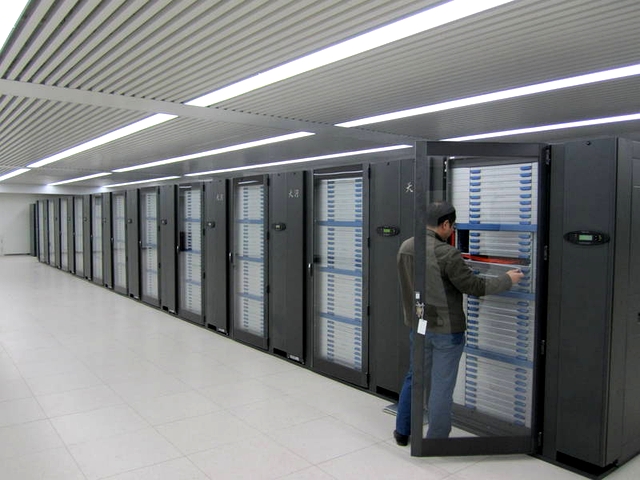 🇨🇳 ChinaTianhe-1
Chinese petascale supercomputer at the National Supercomputing Center in TianjinSupercomputer · Other Nvidia GPUs · 2009
🇨🇳 ChinaNebulae
A petascale supercomputer in Shenzhen built by SugonSupercomputer · Other Nvidia GPUs · 2010