Public research bodies
Universities, labs and national centres. 58 providers on EveryNeocloud so far.
Public research bodies run most of the world's large non-commercial AI and science machines. They include national supercomputing centres, government labs and university consortia, such as Jülich and CSCS in Europe, the US Department of Energy labs, RIKEN in Japan, C-DAC in India and NCI in Australia. They are paid for by taxpayers and share their machines among researchers.
How they work
A centre buys a machine, usually through a public tender, and runs it for five to seven years before replacing it. Time is granted by application. Many centres are joint ventures: EuroHPC machines are co-owned by the EU and host countries, and LUMI is shared by ten countries. Centres also train users and write software that others then reuse.
A changing role
These bodies once owned the fastest computers on earth. Private AI clusters are now larger, so public centres focus on open science, national needs and access for those who cannot pay commercial prices. Many now host AI programmes for start-ups and use their machines to train open models, such as Switzerland's Apertus on Alps.
Famous public research bodies providers
 Forschungszentrum JülichGerman research centre that runs JUPITER
 Swiss National Supercomputing CentreRuns Alps for ETH Zurich
 Barcelona Supercomputing CenterSpain's national centre
 CINECAItalian university consortium that runs LeonardoCentre for Development of Advanced ComputingIndia's C-DACOak Ridge Leadership Computing FacilityUS DOE centre that runs Frontier
 National Computational InfrastructureAustralia's national centre in Canberra
Still to be written: CSC – IT Center for Science.
Further reading
🇪🇸 SpainBarcelona Supercomputing Center
Spanish national supercomputing centre running the MareNostrum machine in BarcelonaResearch cluster · Other Nvidia GPUs · 2005
🇮🇳 IndiaCentre for Development of Advanced Computing
Indian government society building supercomputers and advanced computing systemsSupercomputer · Other and custom chips · 1988
🇺🇸 United StatesOak Ridge Leadership Computing Facility
US Department of Energy supercomputing user facility at Oak Ridge National LaboratorySupercomputer · Other and custom chips · 1992
🇦🇺 AustraliaNational Computational Infrastructure
Australia's national high-performance computing and data facility at ANU in CanberraSupercomputer · Other Nvidia GPUs · 2007
 🇯🇵 JapanK computer
Fujitsu-built Japanese supercomputer at RIKEN, active 2011 to 2019Supercomputer · Other and custom chips · 2011
 🇯🇵 JapanTsubame
A long-running Japanese supercomputer series built for AI and scientific computing.Supercomputer · Nvidia Hopper · 2006
 🇺🇸 United StatesSierra
A US nuclear weapons simulation supercomputer at Lawrence LivermoreSupercomputer · Other Nvidia GPUs · 2018
 🇺🇸 United StatesNERSC
US Department of Energy supercomputing centre for open science researchSupercomputer · Nvidia Ampere · 1974
 🇺🇸 United StatesSequoia
IBM Blue Gene/Q supercomputer built for US nuclear weapons simulation at LivermoreSupercomputer · Other and custom chips · 2011
 🇯🇵 JapanFugaku
A Japanese CPU-based supercomputer built by Fujitsu for RIKEN research work.Supercomputer · Other and custom chips · 2020
 🇪🇸 Spain and 1 moreMareNostrum
Spain's main supercomputer at the Barcelona Supercomputing CenterSupercomputer · Nvidia Hopper · 2005
🇵🇹 PortugalDeucalion
Portugal's fastest supercomputer, hosted at MACC in GuimarãesSupercomputer · Nvidia Ampere · 2023
🇨🇭 SwitzerlandPiz Daint
Swiss national supercomputer at CSCS, upgraded to Cray XC50/XC40 with Tesla P100 GPUsSupercomputer · Nvidia Ampere · 2012
🇨🇳 ChinaNebulae
A petascale supercomputer in Shenzhen built by SugonSupercomputer · Other Nvidia GPUs · 2010
 🇮🇹 Italy and 1 moreGalileo
Italian national Tier-1 supercomputer for scientific and technical computingSupercomputer · Other Nvidia GPUs · 2015
🇮🇳 India and 4 morePARAM
India's home-grown supercomputer line, built by C-DAC in Pune since the early 1990sSupercomputer · Other and custom chips · 1991
 🇺🇸 United StatesAurora
An exascale supercomputer at Argonne National Laboratory built by Intel and Cray.Supercomputer · Other Nvidia GPUs · 2023
 🇺🇸 United StatesTexas Advanced Computing Center
University of Texas centre running supercomputers and storage for U.S. researchResearch cluster · Other Nvidia GPUs · 2001
 🇯🇵 JapanEarth Simulator
Japanese vector supercomputer series built for global climate and solid earth simulation.Supercomputer · Other and custom chips · 2002
 🇨🇳 ChinaNational Supercomputing Center of Tianjin
National supercomputing facility in Tianjin running the Tianhe-1A machineSupercomputer · Other Nvidia GPUs · 1984
 🇯🇵 JapanGyoukou
Immersion-cooled Japanese supercomputer built by ExaScaler and PEZY ComputingSupercomputer · Other and custom chips · 2017
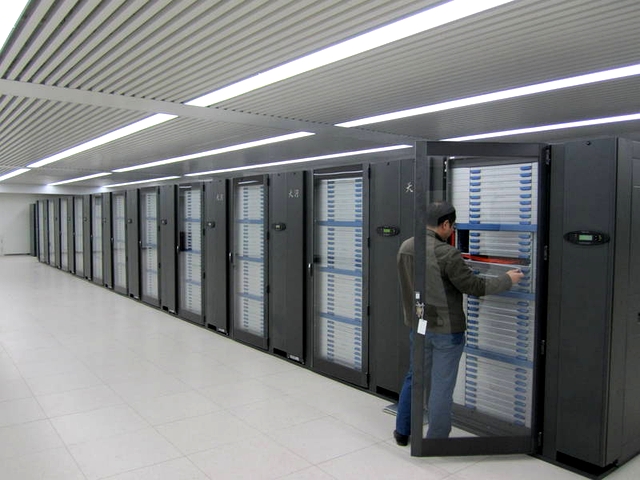 🇨🇳 ChinaTianhe-1
Chinese petascale supercomputer at the National Supercomputing Center in TianjinSupercomputer · Other Nvidia GPUs · 2009
🇸🇦 Saudi Arabia and 1 moreShaheen
KAUST's flagship supercomputer series in Saudi ArabiaSupercomputer · Other and custom chips · 2009
🇱🇺 Luxembourg and 4 moreEuroHPC Joint Undertaking
EU public-private partnership building a pan-European supercomputing and AI infrastructureSupercomputer · Other and custom chips · 2018
 🇺🇸 United StatesRoadrunner
IBM-built hybrid supercomputer at Los Alamos, first to sustain a petaflopSupercomputer · Other and custom chips · 2008
 🇨🇳 ChinaTianhe-2
A 33.86-petaflops supercomputer in Guangzhou, built by NUDT with Inspur.Supercomputer · Other Nvidia GPUs · 2013
Photo credits on this page
The small pictures above come from Wikimedia Commons under free licences. Some are cropped to fit.
- Barcelona Supercomputing Center: Herodotptlomeu, CC BY-SA 4.0, source
- CINECA: Carlo Dani, CC BY-SA 4.0, source
- Swiss National Supercomputing Centre: CSCS, CC BY-SA 3.0, source
- Earth Simulator: Manatee_tw, CC BY-SA 4.0, source
- Roadrunner: LeRoy N. Sanchez, Records Management/Media Services and Operations, Attribution, source
- Forschungszentrum Jülich: Bodoklecksel, CC BY-SA 3.0, source
- Tianhe-2: O01326, CC BY-SA 4.0, source
- Tianhe-1: Nakrut, CC BY-SA 4.0, source
- National Supercomputing Center of Tianjin: Amazingloong, CC BY-SA 4.0, source
- MareNostrum: Martidaniel, CC BY-SA 4.0, source
- Galileo: CINECA, CC BY 2.0, source
- Gyoukou: Kestrel, CC BY-SA 4.0, source
- Aurora: Argonne National Laboratory, Public domain, source
- Texas Advanced Computing Center: UNM Research Data Services, CC BY-SA 2.0, source
- National Computational Infrastructure: Nick-D, CC BY-SA 3.0, source
- K computer: 0-0t, CC BY-SA 3.0, source
- Tsubame: Kestrel, CC BY-SA 4.0, source
- Sierra: U.S. Department of Energy, Public domain, source
- NERSC: U.S. Department of Energy, Public domain, source
- Sequoia: Lawrence Livermore National Laboratory, Public domain, source
- Fugaku: 文部科学省, CC BY 4.0, source